



 2025-03-20 16:55:52
Introduction: The series of tweets on economic statistics works will provide a clear and accessible interpretation of influential economic statistics publications from around the world. In addition to economic statistics works published by publishing houses, it also includes some methodological manuals and special paper collections on economic statistics published by international organizations (OECD, UN, World Bank, IMF, EU, etc.), doctoral dissertations on topics in economic statistics, and some Working Papers from economic research institutions.
Work Information: Hulten, CharlesR., Edwin R. Dean, and Michael Harper, eds. New Developments in Productivity Analysis. Vol. 63. University of Chicago Press, 2001.
"New Developments in Productivity Analysis" is the成果 of Volume 63 in the "Studies in Income and Wealth" series of the National Bureau of Economic Research (NBER), co-edited by leading scholars in the field of productivity research, Charles R. Hulten, Edwin R. Dean, and Michael J. Harper. It gathers 15 core papers and reviews from the 1998 "New Directions in Productivity Analysis" conference, marking a paradigm shift in productivity research at the end of the 20th century. The work responds to the theoretical crisis triggered by the "Solow Paradox" and reconstructs the methodological system of productivity analysis by integrating micro-level dynamic mechanisms, environmental constraint accounting, and innovation in service industry measurement. It systematically reviews the theoretical evolution, methodological debates, and frontier topics of productivity measurement, covering multiple perspectives from macro-level total factor productivity (TFP) to micro-level firm efficiency, and from environmental cost accounting to international comparisons, making it a landmark work in the field of productivity research.
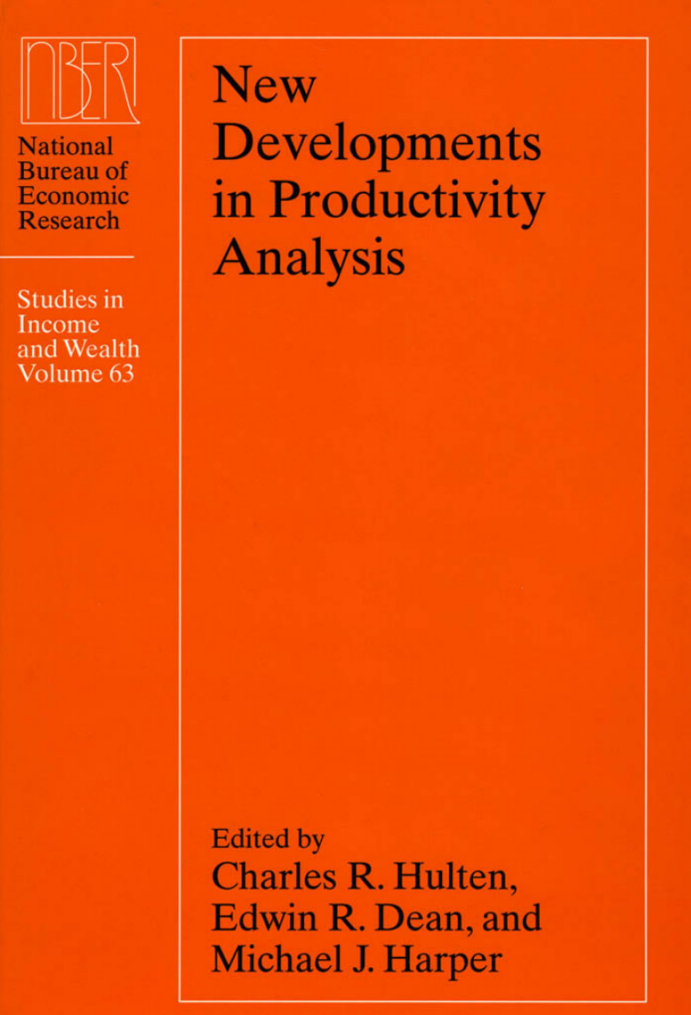
Figure 1. Cover of "New Developments in Productivity Analysis"
Reconstruction of Theoretical Framework and Innovation of Measurement Systems
The core dilemma facing productivity research is the challenge of separating technological progress from factor inputs. In the introductory paper by Hulten (the first paper, "Total Factor Productivity: A Short Biography"), he deconstructs the philosophical foundation of the 'Solow residual,' pointing out that its essence is the potential outward shift of the production possibility frontier, but its actual measurement is constrained by theoretical assumptions about capital quality adjustment and factor substitution elasticity. This critical analysis provides a logical starting point for subsequent methodological innovations. Dean and Harper (the second paper, "The BLS Productivity Measurement Program") reconstruct the BLS multifactor productivity measurement system. Through the perpetual inventory method and the user cost formula, they shift the accounting of capital service flows from a static stock to a dynamic flow analysis, while introducing a labor input index weighted by education level and work experience, giving traditional aggregate analysis a basis for micro-level heterogeneity. Diewert (the third paper, "Which (Old) Ideas on Productivity Measurement Are Ready to Use?") points out that existing multifactor productivity (MFP) studies mostly cover only the three basic data categories of output, labor, and capital, but accurate measurement requires integrating a wider range of input-output categories (such as land, inventories, infrastructure, etc.). He proposes that statistical agencies optimize data collection frameworks (such as unified enterprise identifiers and coordinated price and value surveys) and reorganize institutions to improve cross-sector data consistency.

Figure 2. Professor Charles R. Hulten
Linking Micro Dynamic Mechanisms and Macro Fluctuations
Traditional studies treat productivity fluctuations as passive outcomes of economic cycles. Basu and Fernald (Seventh Chapter, "Why Is Productivity Procyclical? Why Do We Care?") reveal the endogenous generation mechanism by constructing a dynamic general equilibrium framework that includes imperfect competition and increasing returns to scale. Empirical evidence shows that changes in capacity utilization combined with resource reallocation effects jointly explain the procyclical characteristics of productivity, while adjusted technological shocks are negatively correlated with input growth. This finding directly challenges the technological shock-driven hypothesis of Real Business Cycle theory. The study also points out that the differences in markups between industries significantly amplify cycle fluctuations through the resource reallocation channel, rather than the cyclical fluctuations of the markups themselves. Foster et al. (Eighth Chapter, "Aggregate Productivity Growth: Lessons from Microeconomic Evidence")'s analysis of firm dynamics shows that resource reallocation effects account for about 25% of total factor productivity changes during recessions, and the contribution of high-efficiency firm entry is significantly higher than that of low-efficiency firm exit. This asymmetric effect of entry and exit provides a key perspective for understanding the resource reallocation mechanism. By integrating theoretical models with micro-level empirical data, the study reveals the transmission path between cyclical fluctuations and long-term growth, constructing an analysis framework that links micro and macro perspectives.
Greenwood and Jovanovic (Sixth Chapter, "Accounting for Growth") demonstrate, through a model that includes a lag in technology diffusion (an average of 15 years) and a firm-specific learning curve (factory efficiency increases by 15% over years), that the benefits of the information technology revolution exhibit a long-term lag (about 30 years in the baseline scenario). The model also shows that the rise in skill premiums originates from the human capital requirements of adopting new technologies, providing a micro-level basis for understanding skill-biased technological progress, and its diffusion-blocking mechanism offers important theoretical reference value for interpreting technological absorption bottlenecks.
Traditional productivity accounting overlooks the environmental costs of undesirable outputs (environmental externalities). The study by Ball et al. (the thirteenth paper, "Productivity of the U.S. Agricultural Sector: The Case of Undesirable Outputs"), for the first time, incorporated undesirable outputs such as pesticide leaching and nitrogen runoff into the agricultural productivity accounting system by constructing a Malmquist-Luenberger index based on the directional distance function. Empirical results show that between 1972 and 1993, the traditional Malmquist index overestimated productivity growth in some states (such as major corn-producing states) because it ignored environmental costs, whereas the Malmquist-Luenberger index, which accounts for undesirable outputs, indicates that states that reduced pollution generally had higher green TFP growth. Gollop and Swinand (the fourteenth paper, "Total Resource Productivity: Accounting for Changing Environmental Quality") proposed the "Total Resource Productivity" (TRP) accounting framework, incorporating undesirable agricultural outputs (pesticide pollution) into productivity analysis by constructing models of production functions and welfare functions. Empirical evidence shows that between 1979 and 1993, the U.S. agricultural sector experienced higher TRP growth rates compared to traditional TFP while simultaneously reducing pesticide leakage. This study quantified the impact of environmental regulation on productivity by estimating the difference between marginal abatement costs and social marginal damages, providing a shadow price-based micro-optimization path for pollution pricing. Compared with the nonparametric method of Ball et al. (the thirteenth paper), the two approaches respectively form a dual methodological path for environmental productivity accounting through parametric growth accounting and nonparametric frontier analysis: the former reveals the indirect effects of factor substitution and policy costs, while the latter captures the direct impact of environmental constraints on the production frontier.
Baily and Zitzewitz (Chapter 10, 'Service Sector Productivity Comparisons: Lessons for Measurement') highlight the measurement flaws at different levels in the productivity assessment of the service sector through cases such as the measurement bias caused by bank account turnover rates not being included in output indicators, and in the airline industry, where aspects of service quality (such as increased flight frequency due to hub systems) are not covered by the statistical framework. They proposed a cross-country productivity comparison method based on the decomposition of production processes. By field-verifying operational differences (such as the efficiency of the Dutch electronic payment system and bus driver working hours utilization in Sweden), and using the labor share or capital service cost as output weights, they revealed production process optimizations not fully captured by official statistics (for example, the U.S. airline hub system increases service frequency but lowers measured productivity). Their methodology emphasizes correcting data through causal tracing of production processes (such as verifying differences in demand for telecom equipment in Brazil) rather than relying on preset assumptions.
Academic Legacy and Contemporary Value
The milestone significance of the collected volume 'New Developments in Productivity Analysis' lies in establishing a three-dimensional framework for productivity research: at the methodological level, it integrated parameter estimation and non-parametric tools, macro aggregates and micro data; at the theoretical level, it bridged the interactions between technological progress, factor allocation, and institutional environment; at the application level, it expanded the analytical boundaries for environmental constraints, the service economy, and global value chains.
At present, when facing cutting-edge issues such as the productivity effects of artificial intelligence, the measurement of labor input in the gig economy, and the accounting challenges of cross-border data flows, insights may perhaps be drawn from the methodologies presented in this collection. Serving as an academic hub connecting 20th-century growth theory with 21st-century complex economies, its value lies not only in the timeliness of its specific conclusions but also in demonstrating how methodological innovation can address fundamental measurement crises. In the current context, where the data revolution intersects with climate challenges, the methodological framework constructed in this collection provides a classic theoretical reference for solving emerging measurement problems, and its substantial academic value endures over time.
Figure 1 is sourced from the Department of Economics, University of Maryland: https://econ.umd.edu/facultyprofile/hulten/charles-r
Figure 2 is sourced from the National Bureau of Economic Research: https://www.nber.org/books-and-chapters/new-developments-productivity-analysis