



 2025-03-24 16:59:05
Series Introduction:
The Economic Statistics Works Series tweets will provide clear and accessible interpretations of internationally influential economic statistics works. In addition to economic statistics works published by publishing houses, it also includes some methodological manuals and collected papers on economic statistics published by international organizations (OECD, UN, World Bank, IMF, EU, etc.), doctoral dissertations on topics in economic statistics, and selected Working Papers from economic research institutions.
Book Information:
OECD et al. (2002), Measuring the Non-Observed Economy: A Handbook, OECD Publishing, Paris, https://doi.org/10.1787/9789264175358-en.
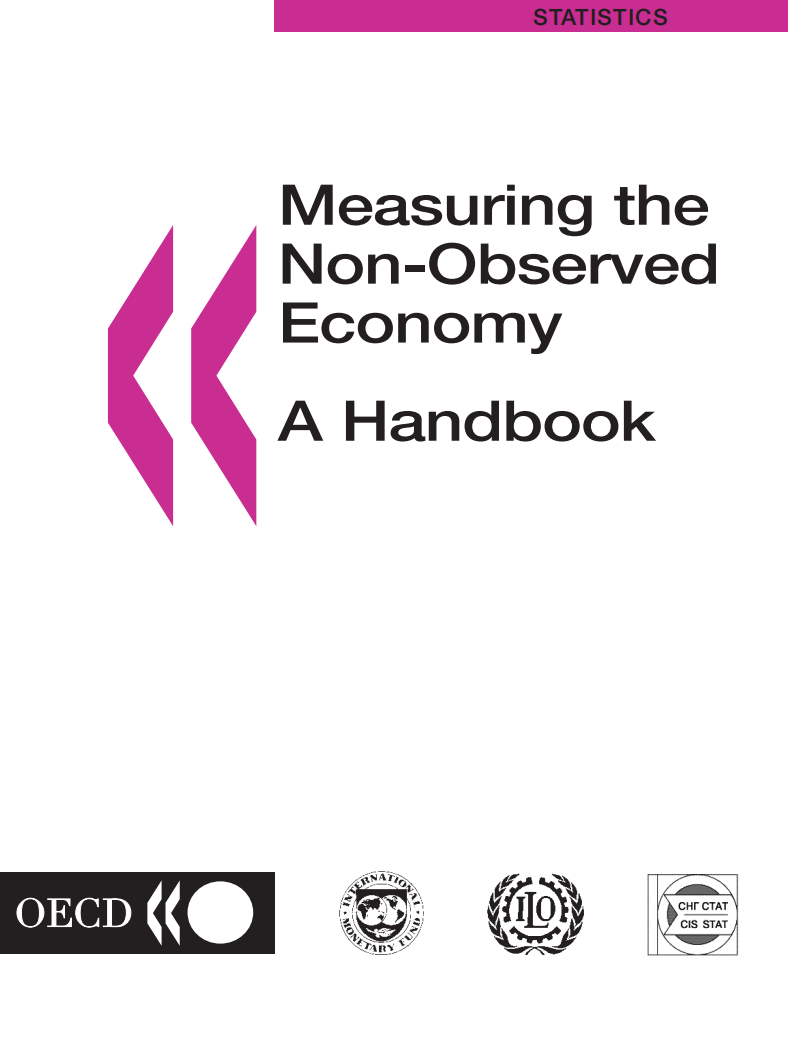
Recommendation | Unveiling the "Unobserved Economy"
Are you curious about how those "invisible" economic activities are measured? How do these "hidden" economic activities impact the overall economy? These questions are all answered in the Handbook on Measuring the Unobserved Economy. This book not only introduces various measurement methods but also provides a large number of practical case studies to help readers better understand and apply them. For professionals in economic statistics, policy research, and related fields, it is a valuable reference tool.
Challenges of Data Blind Spots | Why the Unobserved Economy Matters
For a country, high-quality national economic accounting is very important for economic research and policy formulation. One key aspect of high-quality national accounts is comprehensiveness, which requires that the accounts cover all economic activities. However, achieving comprehensive coverage is difficult because many economic activities are hidden and unobserved. Therefore, this presents many problems for users of the accounts, such as the underestimation of GDP levels and other data, which creates an incorrect picture of the economy, especially when many economic indicators are calculated based on GDP. Data incompleteness not only affects the accurate assessment of the economic situation but may also lead to biases in policy-making and resource allocation. To address this challenge, organizations such as the OECD and the IMF jointly published the Handbook on Measuring the Unobserved Economy in 2002, providing a set of internationally standard measurement frameworks to guide national statistical agencies in optimizing data collection and accounting methods.
Theoretical Foundation and System Construction | What does this manual cover?
The "Handbook on Measuring the Unobserved Economy" is an economic guidebook that reveals the blind spots of traditional national economic accounting. The book takes the United Nations' "System of National Accounts" as its theoretical foundation and constructs a set of internationally applicable classification and measurement frameworks. It revolves around the definitions, classifications, measurement methods, and implementation strategies of the unobserved economy. The book is divided into 12 chapters, which can be summarized into five major parts.
The first part (Chapters 1-3) analyzes the core elements of the national economic accounting system and focuses on the definitions and classifications of the unobserved economy. The second part (Chapters 4-6) discusses measurement methods and data integration, approaching from the perspective of national accounts evaluation, exploring data reconciliation, upper-limit estimation, and the use of supplementary data sources, proposing methods to achieve comprehensive accounting, and providing guidance for optimizing the data collection system. The third part (Chapter 7) formulates implementation strategies and offers suggestions on how different countries can improve data collection and accounting schemes. The fourth part (Chapters 8-11) provides an in-depth analysis of four main types of unobserved economy—underground production, illegal production, informal sector production, and household own-use production—and discusses the corresponding measurement methods and data sources. The fifth part (Chapter 12) addresses estimation methods such as the monetary method, the global indicator method, and the latent variable method, and evaluates their applicability and limitations.
This book provides a systematic theoretical framework and methodology for measuring the unobserved economy, filling the gaps in traditional economic statistics in this area, offering researchers new perspectives and tools. It also challenges traditional economic theories regarding market structure, resource allocation, economic growth models, and promotes innovation and development in economic theory. At the same time, the book stimulates greater interest among statisticians and researchers in the study of the unobserved economy, providing important references and insights for research in this field.
Measuring the 'Invisible Economy' | Five Steps to Measuring the Unobserved Economy
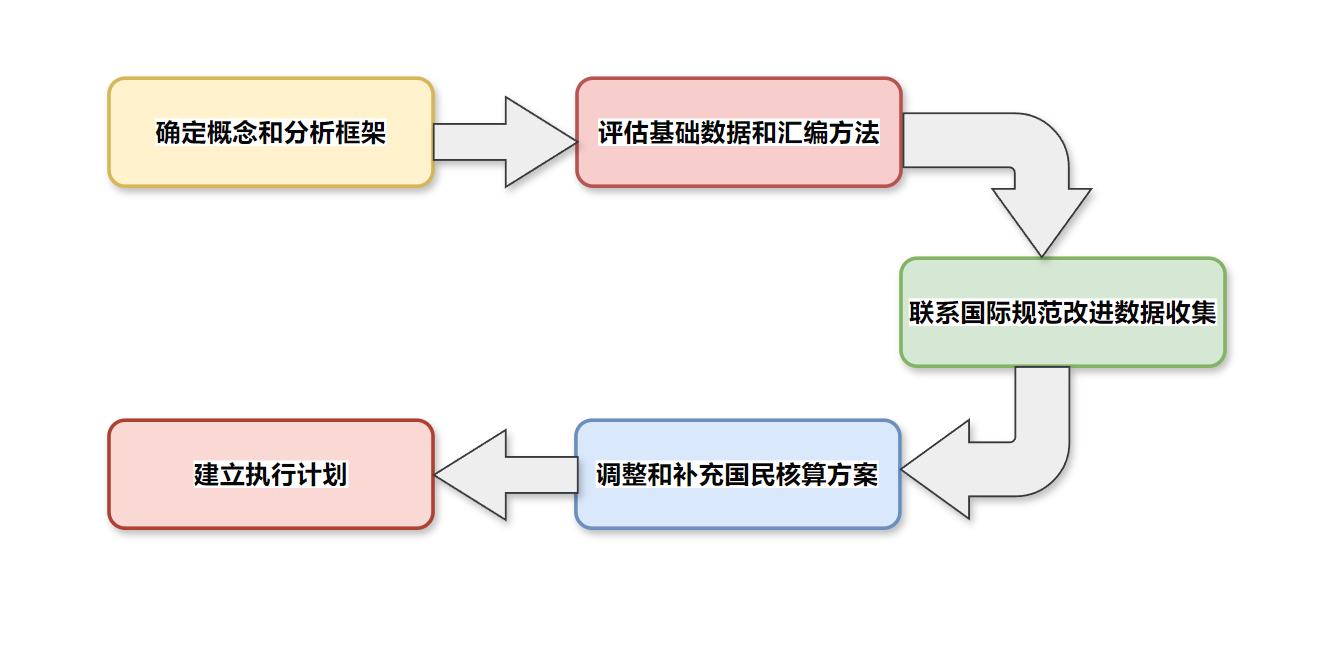
This book proposes a set of procedures for measuring the unobserved economy:
① Clarify concepts and framework: Define the scope of the unobserved economy and establish an appropriate analytical framework.
② Assess basic data: Analyze existing statistical data to identify gaps and shortcomings.
③ Adjust and supplement national accounts: Combine additional survey data to improve statistical coverage and ensure that the impact of the unobserved economy is minimized as much as possible.
④ Optimize data collection plan: Refer to international standards to improve data quality and enhance the integrity of the statistical system.
⑤ Develop an implementation plan: Set specific steps for implementation, including timelines, division of responsibilities, and resource allocation, to ensure that the measurement plan is effectively implemented.
Micro vs. Macro | Two Main Approaches to Quantifying the Unobserved Economy
Regarding methods for measuring the unobserved economy, this book proposes two types of approaches: micro and macro methods:
The micro method measures the observed economy by collecting micro-level data. That is, data is collected and processed, rigorously edited and aggregated to generate reliable basic data, which is ultimately converted into key input items in the national accounting compilation process. However, the micro method can never fully cover all activities within the national accounting system and tends to be costly.
The macro method, on the other hand, uses macroeconomic variables to estimate the unobserved economy. This includes the monetary approach (estimating the size of the underground economy based on cash demand), the global indicator approach (estimating through a combination of multiple economic indicators), and the latent variable approach (constructing statistical models to infer the impact of the unobserved economy), among others, to indirectly estimate the scale and characteristics of the unobserved economy. These methods rely on certain assumptions and provide an effective way to conduct indirect, whole-economy-level analysis when data is insufficient or micro-level data is difficult to obtain [3][4].
Organization Introduction:
The Organisation for Economic Co-operation and Development (OECD) is an intergovernmental international economic organization composed of 38 market economy countries. It was established in 1961 and is headquartered in Paris, France. The purpose of the OECD is to promote economic growth, social welfare, and environmental sustainability among its member countries, while also advancing the coordination of global trade and economic policies. The organization assists member countries in addressing the economic, social, and governance challenges brought by globalization and in seizing the opportunities it presents, through data collection and analysis, policy research, and policy recommendations. The OECD conducts research and policy analysis in multiple areas such as education, environment, finance, labor markets, trade, and investment. Its research findings and reports provide important reference material for governments, policymakers, and researchers worldwide.
The International Monetary Fund (IMF) is a global intergovernmental organization dedicated to promoting international monetary cooperation, ensuring financial stability, fostering international trade, and providing policy advice and financial assistance to help member countries achieve economic stability and growth. By monitoring the global economy, providing financial support, and offering policy recommendations, the IMF helps countries address economic challenges and promotes the stability and development of the global economy. Its published data and reports, such as the World Economic Outlook and the Global Financial Stability Report, serve as valuable references for governments, economists, and researchers.
References:
[1] Lin Yulun. Insights of OECD Classical Unobserved Economy Accounting Theory on China SNA [C] Chinese Society of Quantitative Economics. 21st Century Quantitative Economics (Vol. 10). Graduate School of Chinese Academy of Social Sciences, 2009:53-62.
[2] Tian Guangning, Li Jianjun. Measurement of China's Unobserved Economy Total and Index: 1982–2006 [J]. Quantitative & Technical Economics Research, 2008,(07):138-146.
[3] Liu Dandan. Comprehensive Accounting of Unobserved Economy and GDP [D]. Dongbei University of Finance and Economics, 2003.
[4] Guan Le. Solutions to the Difficulties in Measuring Unobserved Economy—Introduction to OECD Handbook on Measuring the Non-Observed Economy [J]. China Statistics, 2017,(06):29-31.
Graphic and textual sources include but are not limited to:
Organization for Economic Co-operation and Development (https://www.oecd.org/)
International Monetary Fund (https://www.imf.org/)