



 2025-03-27 21:04:49
Series Introduction:
This series of posts on economic statistics publications aims to provide clear and accessible interpretations of influential works in economic statistics worldwide. In addition to books published by academic presses, it also includes methodological manuals and thematic paper collections published by international organizations (such as OECD, UN, World Bank, IMF, EU), doctoral dissertations in economic statistics, and selected working papers from economic research institutions.
Book Information:
van
Praag, Bernard M. S., and Ada Ferrer-i-Carbonell, Happiness
Quantified: A Satisfaction Calculus Approach, 1st edn (Oxford, 2007;
online edn, Oxford Academic, 1 May 2008),
https://doi.org/10.1093/acprof:oso/9780199226146.001.0001,
accessed 17 Mar. 2025.
Since the mid-20th century, economic research has gradually expanded from traditional analyses of material wealth to broader domains of human well-being. However, as an important dimension for measuring human welfare, subjective well-being has long faced methodological challenges in terms of quantitative analysis within economics. In the book Happiness Quantified: A Satisfaction Calculus Approach, Bernard M. S. van Praag and Ada Ferrer-i-Carbonell employ rigorous econometric methods to quantitatively analyze subjective well-being indicators across multiple life domains, including income satisfaction, domain satisfaction, and political satisfaction, providing innovative methods and practical references for the study of subjective well-being in economics.
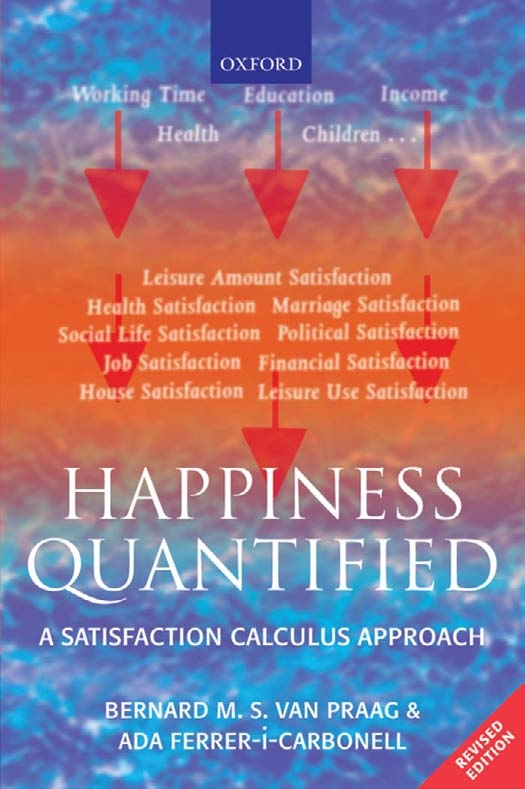

Figure 1. Cover of Happiness Quantified: A Satisfaction Calculus Approach
Background: The Rise and Challenges of Happiness Economics
Happiness economics, as
an interdisciplinary field, mainly focuses on the measurement of
happiness or subjective well-being (SWB) and its impact on economic
behavior and policy. This field integrates perspectives from
psychology, sociology, and economics, aiming to complement
traditional economic analyses of utility and welfare through the
quantification of subjective satisfaction and quality of life.
The
core argument of the book is that although happiness is often
considered incomparable and elusive, it can in fact be systematically
quantified using survey data and modeled for measurement. Subjective
well-being is not merely a simple function of income, but is composed
of satisfaction across multiple life domains (such as health, work,
housing, and social relationships). The authors demonstrate how to
aggregate satisfaction across different domains into “overall life
satisfaction,” providing a deeper analytical pathway for
understanding socio-economic phenomena such as income inequality,
social welfare issues, and public policy design.
The authors
also critique the limitations of current happiness economics. First,
many existing studies rely on subjective self-reported data, which
raises challenges not only in defining and measuring the abstract
concept of “happiness,” but also in addressing individual
differences, cultural variations, and cross-country comparisons.
Second, although a large body of research has explored causal
relationships between happiness and economic variables such as
income, health, and social relationships, there is a lack of
systematic and model-based integration of these factors. Therefore,
how to comprehensively consider these factors within complex
socio-economic environments remains a pressing issue in the field.
Through interdisciplinary theoretical integration and innovations in
econometric modeling, the authors establish a more inclusive and
methodologically rigorous framework for studying subjective
well-being.
Core Theoretical Framework:
Quantitative Analysis of Subjective Well-Being
In Happiness Quantified: A Satisfaction Calculus Approach, the authors build a multidimensional framework for quantifying subjective well-being based on the “Satisfaction Question” (SQ) as a measurement tool. This framework goes beyond traditional approaches by covering individual satisfaction across various life domains (such as income, health, employment, and family life). By introducing the concept of “domain satisfaction,” the authors argue that satisfaction in different life domains is independent, and each domain contributes uniquely to overall happiness. The core of this theoretical framework lies in aggregating satisfaction across domains into “overall life satisfaction” (Aggregation of Satisfactions), forming the two-layer model (The two-layer model). In this model, domain satisfactions serve as independent variables, effectively avoiding issues related to cardinal effects while clearly representing trade-offs among different domains.
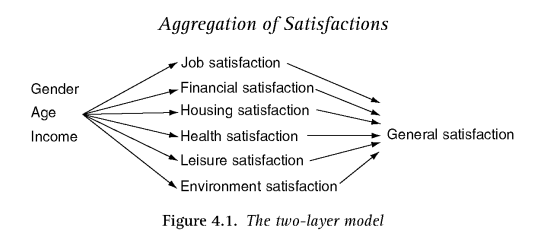
Figure 2. The two-layer model
In addition, the framework incorporates social reference groups and social comparison theory, suggesting that individual satisfaction is deeply influenced by the surrounding social environment. Based on the “social filter” model, the authors point out that individuals do not evaluate their satisfaction in isolation, but rather compare it with the satisfaction levels of their reference groups. This perspective highlights the important role of social comparison in shaping subjective well-being and implies that policy interventions aimed at improving happiness should take into account dynamic socio-economic conditions. Therefore, this framework not only extends traditional economic models but also integrates insights from psychology and sociology, revealing how individual satisfaction is formed through the interaction of personal experiences and social forces, making the book essential reading for scholars interested in the complex dynamics of happiness.
Methodological Innovation: Optimizing Satisfaction Data Analysis
One of the key contributions of the book is the proposal and application of the “Probit OLS” (POLS) method, which efficiently analyzes discrete response data in satisfaction surveys. This method overcomes the high computational complexity and difficulty in model fitting associated with traditional Probit regression when dealing with large and complex nonlinear problems. The advantage of the POLS method lies in its ability to handle large-scale, multidimensional datasets without sacrificing analytical accuracy. By applying the POLS method to different satisfaction domains and proposing a weighted aggregation model that avoids reliance on cardinal comparisons, the authors demonstrate how subjective well-being can be incorporated as a quantitative variable into econometric models. This innovative method provides powerful new tools for empirical research on the complex relationships between individual satisfaction and socio-economic variables, expanding the scope of happiness measurement and social policy analysis.
Academic and Practical Implications: Interdisciplinary Applications and Policy Impact
Happiness Quantified: A
Satisfaction Calculus Approach has had a profound impact across
multiple disciplines and provides innovative solutions to various
real-world problems.
In the field of health economics, the
authors propose a new method for evaluating the effectiveness of
health policies through the quantitative analysis of health
satisfaction. While the traditional indicator “Quality-Adjusted
Life Years (QALY)” evaluates health based on the combined benefits
of improved health status and extended lifespan, the authors argue
that it fails to fully account for individual-level differences.
Based on the trade-off model, they derive the monetary compensation
required to offset welfare losses caused by health problems. This
approach not only reveals a monetary-based method for health
evaluation but also helps policymakers assess the economic value of
different health interventions.
In environmental economics,
particularly regarding noise pollution and climate change, the
authors construct a “climate equivalence scale” to quantify the
impact of different environmental conditions on residents’
well-being. For example, by analyzing the effects of noise pollution
around Amsterdam Airport on housing prices and residents’
happiness, the book proposes new approaches to environmental
compensation. It also reveals how living costs under different
climate conditions affect happiness and provides a basis for
policymakers to adjust welfare and compensation according to regional
climate differences.
In addition, the book explores income
inequality and social welfare issues, proposing a new approach that
incorporates satisfaction measurement into income distribution and
poverty analysis. Through the analysis of income satisfaction, the
authors introduce the concept of a “subjective poverty line,”
arguing that poverty should not be defined solely by income or
material conditions but should also consider individuals’
perceptions and evaluations of their economic situation. This breaks
through the traditional objective poverty line standard and provides
new perspectives for optimizing social welfare and poverty
alleviation policies. Based on this, the authors further propose the
concept of “multidimensional poverty,” emphasizing that poverty
involves not only income but also multiple dimensions such as health,
education, and quality of life. This multidimensional approach offers
a more comprehensive reflection of individuals’ actual living
conditions and provides new insights for poverty research.
Author Introduction

Figure 3. Bernard M. S. van Praag
Bernard M. S. van Praag (born 1939 in Amsterdam,
Netherlands) is a renowned Dutch economist and Professor of Economics
at the University of Amsterdam. He has taught at institutions such as
Vrije Universiteit Brussels, Erasmus University Rotterdam, and Leiden
University. He has also served as the founding president of the
European Society for Population Economics, associate editor of the
Journal of Population Economics and the Journal of Health Economics,
and a member of the Dutch Social and Economic Council. In 1999, he
was elected to the Royal Netherlands Academy of Arts and
Sciences.
Van Praag has long been engaged in research on social
inequality, collective behavior, and social change, and is
particularly known for his work on welfare and happiness measurement.
His research is grounded in critical theory, historical materialism,
and post-structuralism, emphasizing that social change requires
attention not only to economic structures but also to social culture,
identity, and ideology. He has published influential works such as
Society and History: Philosophical and Sociological Perspectives on
Social Change and Culture, Power and Inequality, providing important
theoretical foundations for the study of social theory and
transformation, while also making significant contributions to
econometric methodology, labor economics, and health economics.
Figure 4. Ada Ferrer-i-Carbonell
Ada Ferrer-i-Carbonell (born 1971 in
Sabadell, Spain) is a prominent Spanish economist. She is currently a
professor at the Barcelona School of Economics, a tenured researcher
at CSIC-IAE, a MOVE research fellow, and a researcher at the IZA
Institute of Labor Economics. She has also served as associate editor
of the Journal of Economic Behavior and Organization and is a member
of the World Happiness team at the London School of Economics.
Her
research covers multiple areas in economics, including individual
welfare, subjective well-being, health, income, and risk attitudes.
She has made significant contributions in econometrics, happiness
measurement, environmental economics, and behavioral economics.
Together with Bernard M. S. van Praag, she co-authored two highly
influential works: Happiness Quantified: A Satisfaction Calculus
Approach (2004, Oxford University Press) and The Theory of Happiness
in Economics and Psychology (2007, Oxford University
Press).
Ferrer-i-Carbonell’s academic contributions have had a
profound impact on the field of happiness economics. Her work has
been cited more than 11,000 times in academic and scientific
publications. She has published in top journals such as Nature and
frequently appears in international media outlets such as The
Economist, El País, and Catalan National Radio, providing deep
theoretical insights and empirical evidence for understanding the
complex relationship between individual well-being, happiness, and
economic behavior.
Sources of text and images
include but are not limited to:
Wikipedia (Bernard van Praag -
Wikipedia)
Wikipedia (Ada Ferrer-i-Carbonell -
Wikipedia)
https://christiaanhuygensprijs.nl/bernard-van-praag_300_421a/
Ada
Ferrer-i-Carbonell | Barcelona School of Economics