


 2025-04-07 21:59:26
Series Introduction:
This series of posts on economic statistics publications aims to provide clear and accessible interpretations of influential works in economic statistics worldwide. In addition to books published by academic presses, it also includes methodological manuals and thematic paper collections published by international organizations (such as OECD, UN, World Bank, IMF, EU), doctoral dissertations in economic statistics, and selected Working Papers from economic research institutions.
Book Information:
Tooze, J. Adam (2001), Statistics and the German State, 1900–1945: The Making of Modern Economic Knowledge, Cambridge University Press, Cambridge, UK, https://doi.org/10.1017/S0968565004240070
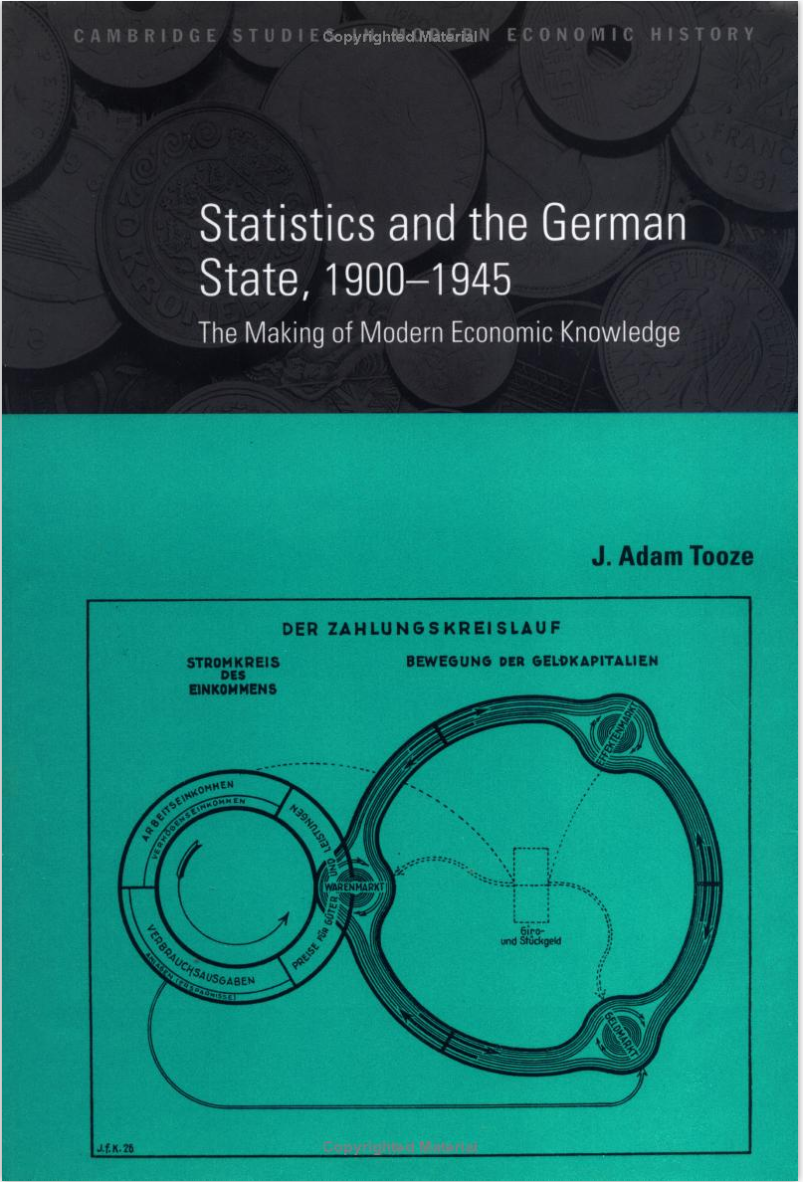
Cover of Statistics and the German State, 1900–1945: The Making of Modern Economic Knowledge
In the glass display cases of the Munich Industrial Museum, the logarithmic slide rule of the Imperial Statistical Office from 1900 stands in silent confrontation with the IBM punch card machine used by the SS in 1944. The former still bears the handcrafted warmth of the guild era in its scales, while the latter carries the cold electric current of totalitarianism in its circuits. These silent mechanical devices are, in fact, the engines of modern state governance: when the wrench of statisticians tightens not the bolts of objective data but the screws of political will, the gears of society begin to collapse through misaligned engagement. The history of German statistics resembles a precise mechanical blueprint, revealing the engineering evolution from artisanal workshops to a digital Leviathan. Every instance of corrosion and innovation tells the same story: the essence of data governance is a mechanical ballet between power and rationality.
01 Official Statistics and Crisis in the Wilhelmine Empire (1900–1914)
In the steampunk-like statistical dilemma of the Hohenzollern dynasty, the institutional framework established by the 1871 Imperial Statistics Law became increasingly absurd amid the tide of industrialization: while Krupp factories roared with the productivity miracle of 120,000 workers, the 1907 Occupational Census Law still divided the industrial landscape using the medieval guild standard of “more than three looms.” This institutional inertia turned the 1910 census into a form of statistical performance art—43% of machinery manufacturers in the Ruhr shared the same classification as rural blacksmith shops, and Siemens turbines were transformed into handicraft specimens in guild ledgers. The technological gap further aggravated systemic dysfunction: 62% of industrial data reported by local associations relied on manual bookkeeping, creating a 20-fold efficiency gap compared to the Hollerith punch card system used in the United States, ultimately resulting in a century-level error where the official industrial employment rate of 38.7% in 1913 diverged sharply from the real value of 55%. The quill of the Imperial Statistical Office persisted in writing pastoral poetry amid the flood of steel, forcibly sealing mechanical giants within the glass bottle of the guild system, thus creating one of the most paradoxical epistemological black holes of the industrial age.
02 The Weimar Republic (1918–1929): Reconstruction of the Statistical System and the Foundation of Modern Economic Monitoring
After the end of World War I in 1918, the newly established Weimar Republic initiated radical statistical reforms under the constraints of the Versailles system. The 1919 Information Obligation Act attempted to reshape the economic landscape through mandatory data reporting, forcing entities ranging from Krupp to corner grocery stores into the same statistical matrix, yet encountered systemic collapse during the hyperinflation of 1923—statistical offices in Berlin found that the monetary values in enterprise monthly reports depreciated by an average of 37% during the printing cycle, reducing the confidence level of industrial output statistics in 1922 to only 18%. A turning point came in 1924, when economist Ernst Wagemann proposed the “circular flow” theory, reconstructing the analytical framework through a national income tri-sector model and leading a team of 200 researchers to build a monitoring system covering 87 industries. By the time the German Institute for Economic Cycle Research (IFK) was established in 1925, its industrial monitoring system could capture production fluctuations down to each ton of coke in the Ruhr, transforming vibrations on Siemens production lines into a 600-page monthly fluctuation atlas. This modern statistical system, forged from punch cards and mathematical formulas, finally enabled Weimar Germany to achieve precise correlations among economic indicators between 1926 and 1929, allowing an average annual growth rate of 7.2% to be clearly displayed on the government dashboard.
03 Statistical Crisis During the Great Depression (1930–1933): Dual Dilemma of Data Failure and Politicization
The global economic crisis of 1929 surged like a high-voltage current through an aging circuit, destroying the fragile statistical framework of the Weimar Republic. Traditional forecasting models failed under the dual pressures of surging unemployment and collapsing output, and the trust mechanism painstakingly built over a decade between the government and statistical institutions collapsed completely by the summer of 1931. The Brüning cabinet publicly confronted the statistical office over the methodology of the cost-of-living index, and unemployment data became a tool of political struggle—Nazi propaganda systematically manipulated statistical definitions to portray the economic disaster as the original sin of democracy. At the same time, the German Institute for Economic Cycle Research (IFK), whose predictive model based on 150 indicators opposed austerity policies, was suppressed, and its 17 warning reports from 1929 to 1932—particularly the core conclusion that deflation would trigger an economic death spiral—were entirely silenced. This crisis ultimately transformed the function of statistical data: the actual unemployment rate of 31.8% calculated by the institute was processed into a “legal unemployment rate” of 25.1% by the Nazi propaganda machine. This precisely targeted tool of public opinion not only dismantled the last pillar of Weimar’s evidence-based governance system but also led to the complete collapse of the socio-economic order under the resonance of ideological manipulation and technological dysfunction.
04 Statistical Transformation Under the Nazi Regime (1933–1939): From Economic Control to Totalitarian Surveillance
After the Nazis came to power in 1933, Germany’s statistical system was systematically transformed into the central control hub of a totalitarian machine: in the early stage (1933–1936), the regime retained the statistical framework of the Weimar period while enforcing enterprise cooperation under the “Four-Year Plan,” using Hollerith punch card technology to monitor labor and strategic resources, turning economic data into engines of war mobilization; population statistics, through “scientific” racial classification, provided empirical justification for racial cleansing. As the regime became increasingly radical (1936–1939), the focus of statistics shifted entirely toward micro-level surveillance, replacing traditional economic statistics with monitoring networks covering employment, consumption, and migration. However, this system encountered resistance from enterprises and internal conflicts within the Party. By the eve of World War II in 1939, statistical institutions had been subordinated to the SS economic command. Steel production in the Ruhr and the allocation of concentration camp prisoners were integrated into a single system, forming a so-called “scientific” pairing. At this stage, statistical reports were no longer mirrors of reality but digital molds for manufacturing death, culminating in their ultimate distortion within the crematoria of Auschwitz.
05 World War II and the Dual Trajectory of Postwar Statistics (1939–1945): From War Instrument to Reconstruction of Economic Science
During World War II, the Nazi statistical system was fully militarized: mechanical data processing technologies and macroeconomic models such as the “General Plan” were forcibly applied to war resource allocation, while racist ideology continuously distorted data logic—concentration camp prisoners and steel output were listed side by side as “production factors,” reducing statistics to a subordinate algorithm of predatory warfare. After the war, West Germany’s statistical reconstruction initiated a process of de-Nazification: the Allied occupation authorities restored the scientific neutrality of statistical institutions and recalibrated the national accounting framework to align with the international standards of the Marshall Plan; the Federal Statistical Office gradually removed ideological distortions by introducing modern methods such as sample surveys and input–output tables. By the late 1950s, Germany’s statistical system completed its transformation from totalitarian surveillance to economic science, and the transparent data network it constructed not only supported Erhard’s “social market economy” but also turned statistics into a rational foundation for modern economic governance.
Conclusion:
From the industrial misjudgments of the Wilhelmine Empire to the death reports of Auschwitz, the history of German statistics is essentially a record of the struggle between power and rationality: when machinery factories in the Ruhr shared statistical codes with blacksmith shops in 1913, the seeds of epistemological crisis had already been planted; the sophisticated monitoring network of the Weimar period ultimately became an algorithmic engine for Nazi propaganda. This decades-long turbulence reveals not only the fragility of technical tools but also the deeper dilemmas of modern governance. Statistical data are a double-edged sword: the Nazis used the Hollerith system to include crematorium fuel in production reports, while West Germany used the same technology to support its economic miracle. The difference lies not in the machines, but in the institutional constraints. In an era when artificial intelligence is reshaping the boundaries of statistics, the historical experience of Germany serves as a powerful warning: the ultimate test of data governance lies in resisting the coloring of power. The real unemployment data preserved in East German archives demonstrate that even in darkness, the pursuit of truth persists within statistics. Today, the unfinished dialogue displayed in museum cases reminds us that when every data point can become a tool of power, it is more important than ever to remember that the value of statistics depends on its proximity to truth.
Author Introduction:

J. Adam Tooze
J. Adam Tooze holds a Ph.D. from the London School of Economics and has taught at the University of Cambridge and Yale University. He is currently a professor of history and director of the European Institute at Columbia University. His research spans 20th-century and contemporary economic history, political history, intellectual history, and military history, with a particular focus on crisis studies, including financial crises and economic collapses. His major works include Statistics and the German State, 1900–1945: The Making of Modern Economic Knowledge, The Wages of Destruction: The Making and Breaking of the Nazi Economy, The Deluge: The Great War and the Remaking of Global Order, Crashed: How a Decade of Financial Crises Changed the World, and Shutdown: How Covid Shook the World’s Economy, many of which have received international awards. Tooze is not only an accomplished scholar but also actively participates in global policy discussions, frequently attending forums such as Davos and providing economic advisory support to policymakers. Known for his interdisciplinary perspective and narrative of crises, his work deepens the understanding of 20th-century economic history and offers historical insights for addressing contemporary global challenges.
Sources:
[1] Aly, G., &
Roth, K. H. (2004). The Nazi census: Identification and control in
the Third Reich. (E. Black, Trans.). Philadelphia: University of
Pennsylvania Press.
[2] Statistisches Bundesamt. (1999).
Statistisches Bundesamt: Geschichte und Aufgaben (1949–1999).
Wiesbaden: Statistisches Bundesamt.
Image
sources:
https://www.amazon.com/Statistics-German-State-1900-1945-Knowledge/dp/0521803187
https://www.jiemian.com/article/7873340.html