



 2025-04-08 22:06:19
Series Introduction:
This series of posts on economic statistics publications aims to provide clear and accessible interpretations of influential works in economic statistics worldwide. In addition to books published by academic presses, it also includes methodological manuals and thematic paper collections published by international organizations (such as OECD, UN, World Bank, IMF, EU), doctoral dissertations in economic statistics, and selected Working Papers from economic research institutions.
Book Information:
OECD (2025), Global Debt Report 2025: Financing Growth in a Challenging Debt Market Environment, OECD Publishing, Paris, https://doi.org/10.1787/8ee42b13-en.
In today’s complex global economic environment, debt has become a central issue that policymakers and market participants cannot avoid. Since the 2008 financial crisis and the COVID-19 pandemic, debt markets have played an indispensable role in supporting economic recovery, but have also brought unprecedented challenges. Global Debt Report 2025 provides profound insights into the current state, challenges, and future directions of global debt markets. Through detailed data analysis and original research, it seeks to reveal the underlying logic of debt markets and offer strategies for addressing future challenges.
Figure 1. Cover of Global Debt Report 2025
Real-World Context: Economic Recovery Under Multiple Pressures
Currently, global debt has risen to approximately $100 trillion, reaching a historical high. Following the dual shocks of the 2008 financial crisis and the COVID-19 pandemic, debt-driven recovery has prevented deep economic contraction but has also planted long-term risks. As monetary policy shifts from easing to tightening, rising interest rates are increasing debt burdens, particularly in emerging markets and low-income countries. These economies face multiple pressures, including currency depreciation, high inflation, and limited fiscal space, making debt management increasingly complex. In addition, global debt markets are confronted with geopolitical tensions, trade policy uncertainty, and financing demands for climate transition. Policymakers worldwide face the critical challenge of ensuring debt sustainability while financing investments necessary for competitiveness and long-term growth. The report provides policy references by analyzing sovereign bond markets in OECD and emerging economies, global corporate debt markets, and debt financing for climate transition.
Core Theoretical Framework: Dual Pressure of High Interest Rates and High Debt
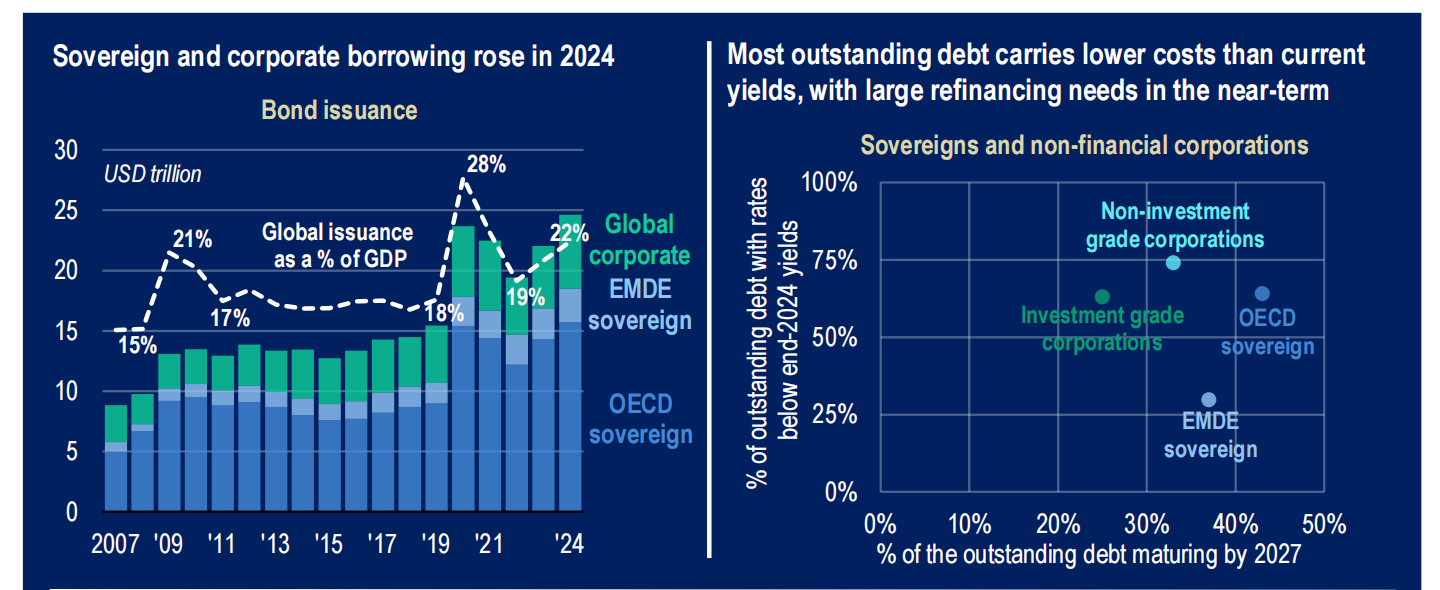
Global Debt Report 2025 highlights that global debt markets are under multiple pressures, including high interest rates, elevated debt levels, and macroeconomic uncertainty. Although inflation declined in 2024, rising borrowing costs and increasing debt burdens constrain future borrowing capacity. Sovereign debt levels continue to rise, with OECD debt-to-GDP ratios reaching 84% in 2024 and expected to increase to 85% in 2025. Sovereign bond issuance in OECD countries is projected to reach a record $17 trillion in 2025, exceeding $16 trillion in 2024 and $14 trillion in 2023. Due to legacy effects from the low-interest-rate era, much outstanding debt carries rates significantly below current market levels, implying substantial refinancing needs in the future—this is particularly evident for non-investment-grade firms and EMDE sovereigns. Corporate debt continues to grow, but new borrowing comes at higher costs, increasing future interest expenses. Moreover, corporate borrowing is increasingly used for financial operations such as refinancing and shareholder returns rather than productive investment, weakening debt sustainability.
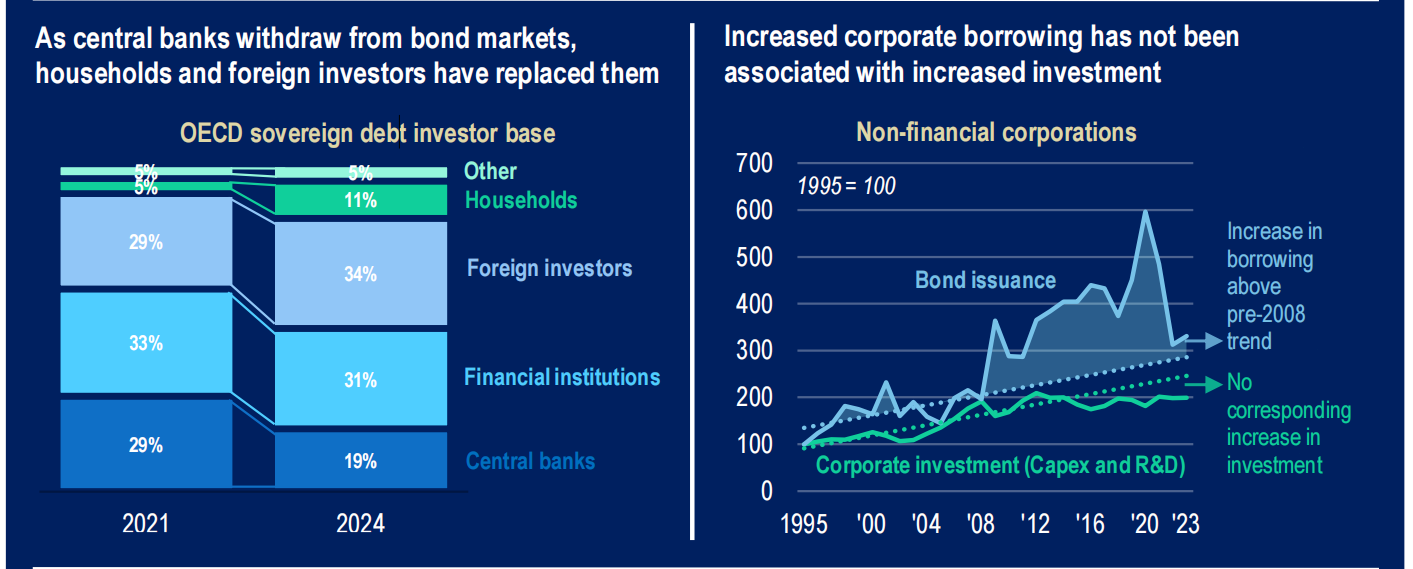
In 2024, central banks continued withdrawing from debt markets through quantitative tightening. Maintaining current debt levels requires existing investors to absorb more debt or new investors to enter the market. Trends in 2024 show that households and foreign investors are replacing central banks’ holdings; however, global policy uncertainty increases the volatility of foreign investor demand, potentially destabilizing markets.
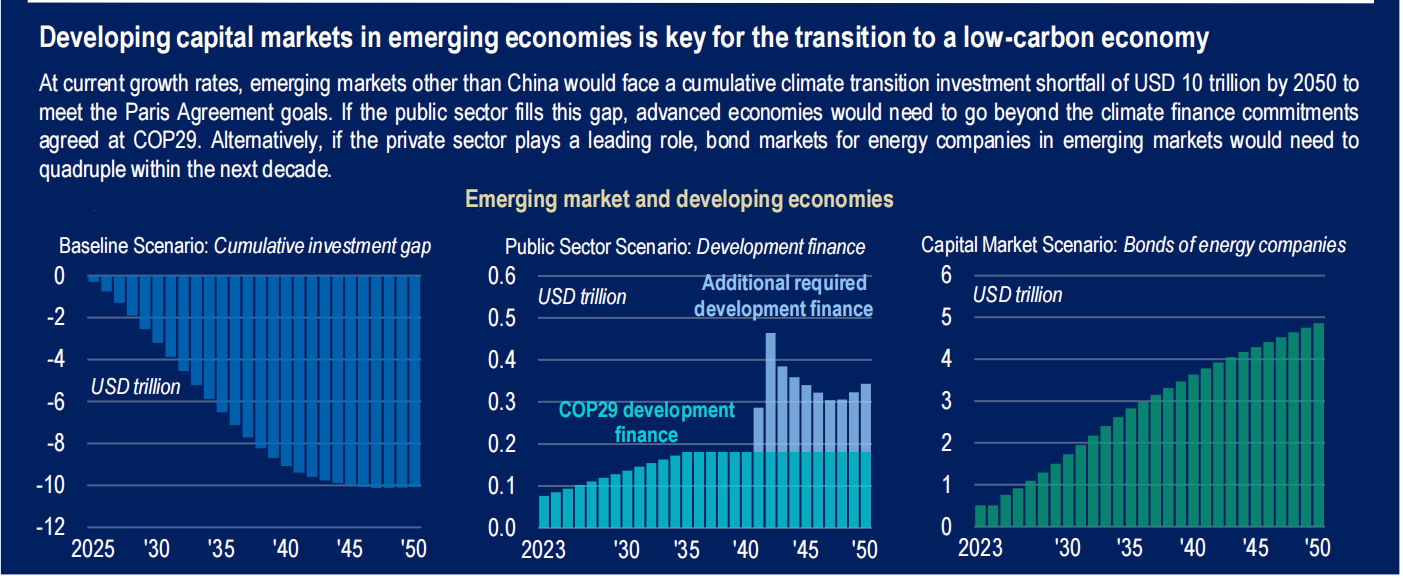
The transition toward net-zero emissions is occurring in an environment of high debt and high financing costs. Both public and private sectors need to increase investment, particularly in emerging and developing economies that require stronger support. Debt financing demand in the energy sector is expected to rise significantly, making capital market reform essential. The report recommends prudent fiscal policy, more efficient public spending, prioritizing productive corporate investment, strengthening local capital markets in emerging economies, and enhancing international climate finance support. Global debt markets are at a critical turning point, requiring policy innovation and market reform to ensure sustainability while supporting long-term growth and climate transition.
Research Approach: In-Depth Analysis of Debt Markets
The report uses sovereign borrowing outlook surveys to collect data on gross borrowing needs, redemptions, and outstanding debt, applying a core definition of central government marketable debt to ensure comparability. It employs debt decomposition models to analyze changes in debt-to-GDP ratios, considering factors such as effective interest rates, primary balances, inflation, and real GDP growth.
For corporate debt markets, the report uses transaction-level data from LSEG to analyze bond issuance, excludes specific bond types, and applies ratings from three agencies to classify bonds. It calculates outstanding debt and weighted average borrowing costs, and uses the Herfindahl–Hirschman Index (HHI) to measure market concentration and assess systemic risk.
For emerging market and developing economy sovereign debt markets, the report uses LSEG data and IMF classifications to categorize countries by income level, analyzes issuance including reopened bonds, and evaluates credit ratings and primary market yields.
In climate transition financing, the report draws on international taxonomies and uses scenario analysis to assess financing needs. It combines LSEG, IEA, and OECD data to evaluate capital structures and investment demand in the energy sector. It also introduces new indicators of market liquidity and investor behavior—such as yield curve dynamics, trading volume, bid–ask spreads, and market depth—as well as investor positioning, risk appetite, sentiment indicators, and capital flows to better understand market dynamics.
Implications and Recommendations: Policy and Market Strategies
Global Debt Report 2025 provides comprehensive insights into debt market conditions, challenges, and trends, offering valuable guidance for policymakers, market participants, and investors. It emphasizes the importance of debt management under complex financial conditions and outlines measures to ensure sustainability.
For sovereign debt, policymakers must balance borrowing needs and costs while accounting for liquidity and investor composition. Optimizing debt structure—through longer maturities and diversified financing channels—can reduce refinancing risk. Improving transparency and predictability in debt management is also key to strengthening market confidence and lowering financing costs.
For corporate debt, rising borrowing costs require more prudent debt management. Firms should prioritize productive investment rather than financial engineering, while investors should assess debt sustainability and avoid excessive concentration.
For emerging markets and developing economies, accelerating the development of local currency bond markets can reduce reliance on external financing and mitigate exchange rate risks. Strengthening fiscal discipline and transparency can also attract stable investor bases.
For climate transition financing, both public and private sectors must play critical roles. Policymakers should use incentives and regulatory reforms to encourage investment in climate projects, while the international community should expand financial support for developing economies to bridge funding gaps.
Academic Value and Significance: Interdisciplinary Dialogue in Debt Economics
Against the backdrop of rising global debt, Global Debt Report 2025 offers a comprehensive theoretical and practical framework by analyzing debt market dynamics and their socio-economic implications. In the context of sustained debt accumulation since the 2008 financial crisis and the COVID-19 pandemic, the report fills gaps in traditional economic theory and addresses contemporary challenges in debt management through an interdisciplinary approach.
By integrating the unique characteristics of debt markets with economic theory, it directly connects academic research with policy and market practice. Through innovative data and analytical methods, it provides rich material for research on debt dynamics, market uncertainty, and climate finance. More importantly, it confronts the socio-economic challenges of debt and seeks a balance between stability and growth. By combining perspectives from economics, finance, and environmental science, it builds a bridge for cross-disciplinary dialogue.
The report sets a broad agenda for global debt economics and will serve as an authoritative reference in the years ahead. It provides not only valuable academic insights but also practical guidance for policymaking and market strategy, particularly in addressing high debt levels, climate transition financing, and market uncertainty.
Editor Introduction
Figure 2. Carmine Di Noia
Carmine Di Noia is Director for Financial and Enterprise Affairs at the OECD. He leads OECD work on corporate governance, anti-corruption, responsible business conduct, competition, financial education and consumer protection, capital markets, investment, pensions, insurance, public debt management, and blockchain. He previously served as Commissioner of the Italian Securities and Exchange Commission (CONSOB), alternate board member of IOSCO, and alternate member of the ESMA Board of Supervisors. He has chaired ESMA committees and served as Vice-Chair of the OECD Corporate Governance Committee. He is also a full professor at LUISS Business School in Rome, teaching financial markets and banking. His publications include works on financial regulation and supervision in Italy and the Euro Area.
Image
sources:
https://www.oecd.org/en/about/directorates/directorate-for-financial-and-enterprise-affairs/carmine-di-noia.html
https://www.oecd.org/en/publications/global-debt-report-2025_8ee42b13-en/full-report/key-facts-and-figures-infographic_aef01860.html#introduction-d5e1050