


 2025-04-13 22:09:36
Series Introduction:
This series of posts on economic statistics publications aims to provide clear and accessible interpretations of influential works in economic statistics worldwide. In addition to books published by academic presses, it also includes methodological manuals and thematic paper collections published by international organizations (such as OECD, UN, World Bank, IMF, EU), doctoral dissertations in economic statistics, and selected Working Papers from economic research institutions.
Book Information:
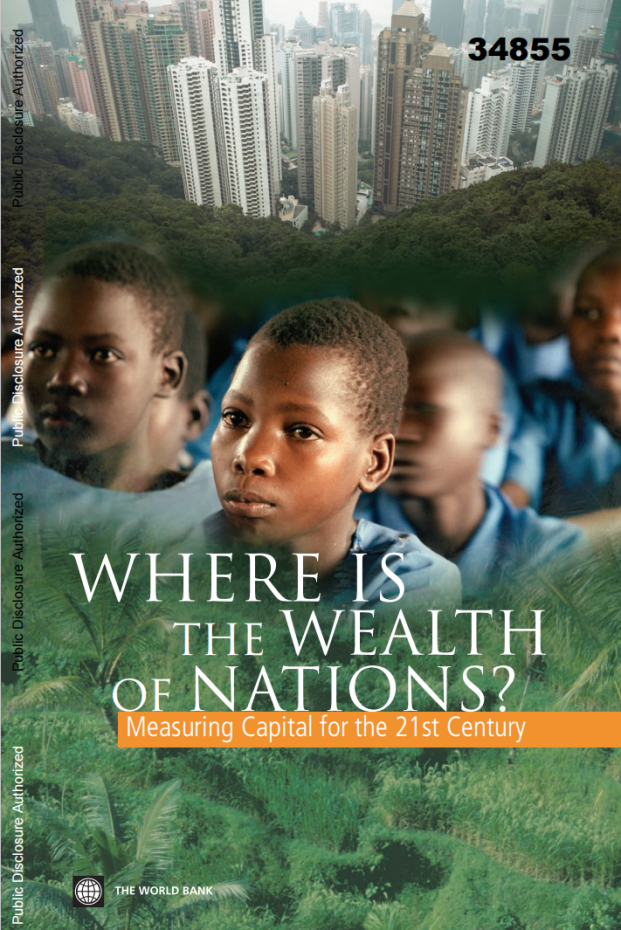
Hamilton, K., Ruta, G., Bolt, K., Markandya, A., Pedroso-Galinato, S., Silva, P., Ordoubadi, M. S., & Lange, G.-M. (2006). Where Is the Wealth of Nations? Measuring Capital for the 21st Century. The World Bank, Washington, D.C. ISBN: 978-0-8213-6354-6. http://doi.org/10.1596/978-0-8213-6735-3
Figure 1. Cover of Where Is the Wealth of Nations?
Introduction
Since the beginning of the 21st century, global environmental challenges have intensified, making sustainable development a central issue for the international community. The World Bank’s 2006 publication Where Is the Wealth of Nations? Measuring Capital for the 21st Century provides an innovative framework for assessing sustainability by quantitatively analyzing the composition of national wealth. Breaking away from traditional economic measurement standards, the book constructs a three-dimensional capital framework that, in addition to produced capital (such as infrastructure) and natural capital (such as minerals and forests), systematically incorporates intangible capital (including human capital and institutional quality). It further introduces the key concept of “genuine saving” to evaluate sustainability. The forward-looking nature of this framework has become increasingly evident in recent years: as climate crises deepen, resource pressures intensify, and social inequality expands, this multidimensional approach offers a robust methodological foundation for subsequent research. Re-examining its systematic treatment of intangible capital and its dynamic evaluation methods reveals important insights for addressing contemporary development challenges.
Invisible Wings
Intangible
Capital as the Driver of Growth
Based on comprehensive data from 120 countries around the year 2000, Where Is the Wealth of Nations? provides the first quantitative demonstration that intangible capital—comprising human capital, institutional quality, and social trust—has become the core pillar of national wealth, accounting for more than 50% of global wealth and rising significantly with income levels. In high-income countries, this share reaches as high as 80%, highlighting the multiplier effect of “soft infrastructure” such as education and rule of law on innovation. In contrast, natural capital exhibits strong income gradients: in low-income countries, nearly 70% of wealth depends on agricultural land, but its contribution declines marginally during industrialization, confirming the potential “resource curse.” Produced capital maintains a relatively stable global share of about 18%, peaking in intensity during industrialization in middle-income countries but declining in high-income economies due to diminishing marginal returns. Through dynamic analysis of capital structure, this research breaks through the limitations of traditional growth theory and lays a theoretical foundation for countries seeking to overcome path dependence and build new sustainable development systems.
Savings Engine
Savings
Indicators Driving Sustainable Development
The concept of “genuine saving” introduced in the book provides an innovative method for evaluating sustainability. It extends beyond traditional net saving by incorporating natural resource depletion, environmental damage, and investment in human capital. This comprehensive indicator offers a new perspective for assessing national wealth and future development potential. Empirical findings suggest that genuine saving rates are a key indicator of sustainability, with negative rates signaling declining national wealth and threats to future welfare.
The Hartwick Rule further emphasizes the importance of reinvesting resource rents into other forms of capital. It suggests that to maintain sustainable consumption, countries should invest rents from non-renewable resources into produced capital, thereby offsetting resource depletion and maintaining total capital at a stable level. Had resource-dependent countries followed this rule since 1970, their stock of produced capital by 2000 would have been significantly higher, providing stronger support for sustainable development.
At the same time, population growth plays a critical role in shaping wealth dynamics. The study shows that maintaining existing wealth levels under population growth requires higher saving rates. In Sub-Saharan Africa, many countries face severe saving gaps, requiring not only increased saving but also optimized investment structures to ensure efficient resource allocation. These findings highlight the need for integrated policy responses to balance population growth, resource use, and environmental protection in achieving long-term prosperity.
Population Tides
Dynamic
Changes Reshaping Wealth Distribution
Population growth significantly affects wealth dynamics. The study shows that when population growth is positive, maintaining wealth per capita requires higher saving rates. For example, in Sub-Saharan Africa, saving gaps—defined as the additional saving required to maintain per capita wealth—range from 10% to 50% of gross national income (GNI). This highlights the dilution effect of population growth on wealth. Addressing this challenge requires integrated policies, including increasing saving rates and optimizing investment structures to ensure efficient resource utilization and sustainable wealth growth.
Green Accounts
Activating
a New Policy Engine
Where Is the Wealth of Nations? systematically demonstrates the transformative significance of environmental accounting as a policy tool. It proposes a four-component framework consisting of natural resource balance sheets, pollution flow accounts, environmental expenditure accounts, and green GDP adjustments, reshaping the foundation of traditional policy analysis. By integrating multidimensional data on ecological capital stocks, pollution intensity, and environmental investment, environmental accounts move beyond GDP-centric perspectives to construct a dynamic, cross-sectoral quantitative model.
The book emphasizes the decision-making value of continuous time-series data: Australia uses land degradation accounts to optimize agricultural subsidies, Canada applies carbon accounts to calibrate energy taxes, Germany reshapes Industry 4.0 strategies through ecological footprint accounting, and Japan adjusts social security systems based on environmental capital depreciation rates. These practices demonstrate the dual nature of environmental accounts—as both an “ecological CT scanner” for evaluating policy externalities and a policy algorithm translating green development into actionable measures.
Unlike traditional statistical systems focused on current economic flows, environmental accounts quantify changes in natural capital stocks (such as forest volume) and accumulated pollution (such as CO₂ stocks), transforming intergenerational equity into measurable policy parameters. They not only assign economic value to environmental assets but also bridge environmental monitoring, economic modeling, and strategic planning, embedding natural constraints into policy design and fostering more resilient governance systems.
Theoretical Evolution
Paradigm
Shift in Sustainability Assessment and Contemporary Implications
Through layered theoretical innovation, Where Is the Wealth of Nations? reconstructs the framework for sustainability assessment. First, it establishes the central role of intangible capital through empirical analysis across 120 countries, fundamentally reshaping traditional development evaluation. Second, it introduces “genuine saving” as a dynamic indicator incorporating environmental and human capital factors. Finally, it translates these innovations into practical policy tools through environmental accounting systems, from resource balance sheets to green GDP adjustments.
This framework has demonstrated strong adaptability in practice. For example, carbon border adjustment mechanisms reflect the policy application of environmental accounting concepts. Similarly, challenges in valuing data assets in the digital economy highlight the relevance of returning to fundamental concepts of wealth. Looking forward, the study offers a dual lesson: it is essential to uphold core principles such as intergenerational equity while continuously innovating measurement tools to address emerging challenges such as data and artificial intelligence. This balance between continuity and innovation represents the enduring intellectual legacy of the work.
Author Introduction

Kirk Hamilton
Kirk Hamilton is a former Chief Environmental Economist at the World Bank and currently a professor of environmental economics at the London School of Economics. As a leading scholar in sustainability measurement, he pioneered the theory of “genuine saving,” which has become a core methodology in the UN System of Environmental-Economic Accounting (SEEA). His work Where Is the Wealth of Nations? redefined development assessment paradigms, and he has authored numerous books including Green National Accounting and Beyond GDP. His research has been adopted by the World Bank, OECD, and governments in over 50 countries. Hamilton has also served as a policy advisor to the United Nations and contributed to the development of the Paris Agreement framework. Known for his interdisciplinary approach, he integrates ecology, economics, and policy analysis to provide critical tools for sustainable development decision-making.
References:
• World Bank. (2006). Where
Is the Wealth of Nations? Measuring Capital for the 21st Century.
Washington, D.C.: The World Bank.
• Hamilton, K., &
Clemens, M. (1999). “Genuine Savings Rates in Developing
Countries.” World Bank Economic Review,
13(2), 333–356.
• Pearce, D. W., & Atkinson, G. (1993).
“Capital Theory and the Measurement of Sustainable Development: An
Indicator of Weak Sustainability.” Ecological
Economics, 8(2), 103–108.
• Arrow, K. J., Dasgupta, P.,
& Mäler, K.-G. (2003). “Evaluating Projects and Assessing
Sustainable Development in Imperfect Economies.” Environmental
and Resource Economics, 26(4), 647–685.
• World Bank.
(2023). “Wealth Accounting and the Economics of Natural Resources.”
Policy Research Working Paper, World Bank, Washington, D.C.
Image
sources:
https://openknowledge.worldbank.org/entities/publication/330b17c3-c123-5e89-8ca7-4432ef0f1c95
https://blogs.worldbank.org/en/team/k/kirk-hamilton